The gap nobody fills
You forgot a name again. You reread the same paragraph. Somewhere between “everyone does that” and “I should get this checked” there is nothing — no test you'd take on a Tuesday evening, and nothing online that doesn't end in a scare or a sales pitch.
Five calm minutes
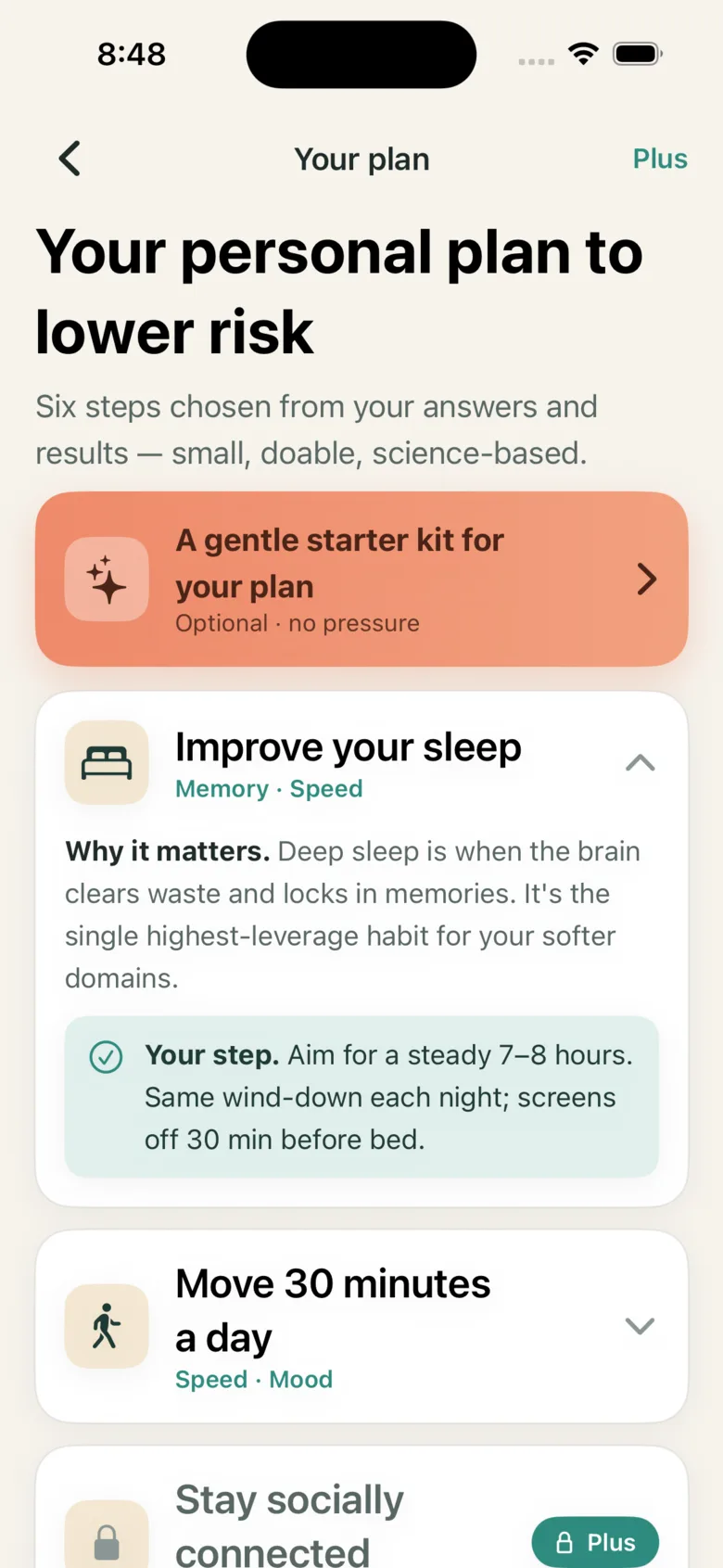
NeuroAge gives you a real screening you can take alone, on your couch: a short questionnaire about the things that actually shift dementia risk, four cognitive tasks, and one number — your brain age — with the honest, un-dramatic explanation of what's behind it and what to do next.
One number, honestly calculated
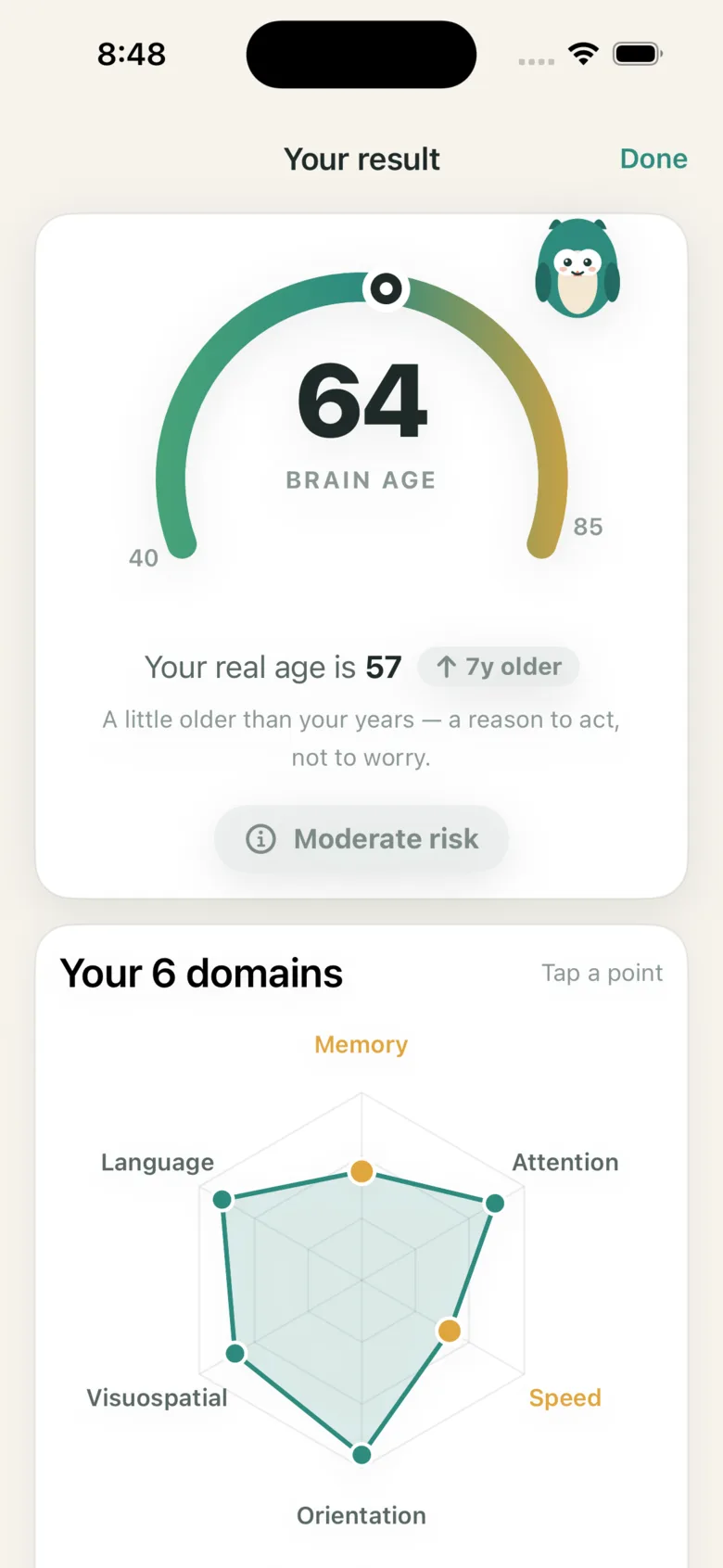
Your brain age comes out of your own answers and task timings — nothing is pre-baked. Next to it sits your real age and a risk band in green, slate or amber; never red, never a scare.
Six domains, not one score
The radar shows where you're strong and where you're a little softer, across the six domains a clinician would look at: memory, attention, processing speed, orientation, visuospatial and language. Tap any one to read what it measures and what helps it.
Explained like a person would.
Your result comes with a written read — your two softest domains, in plain words, plus the single step that helps them most. Built from your own scores, so it can never contradict your radar.
A plan, not a verdict
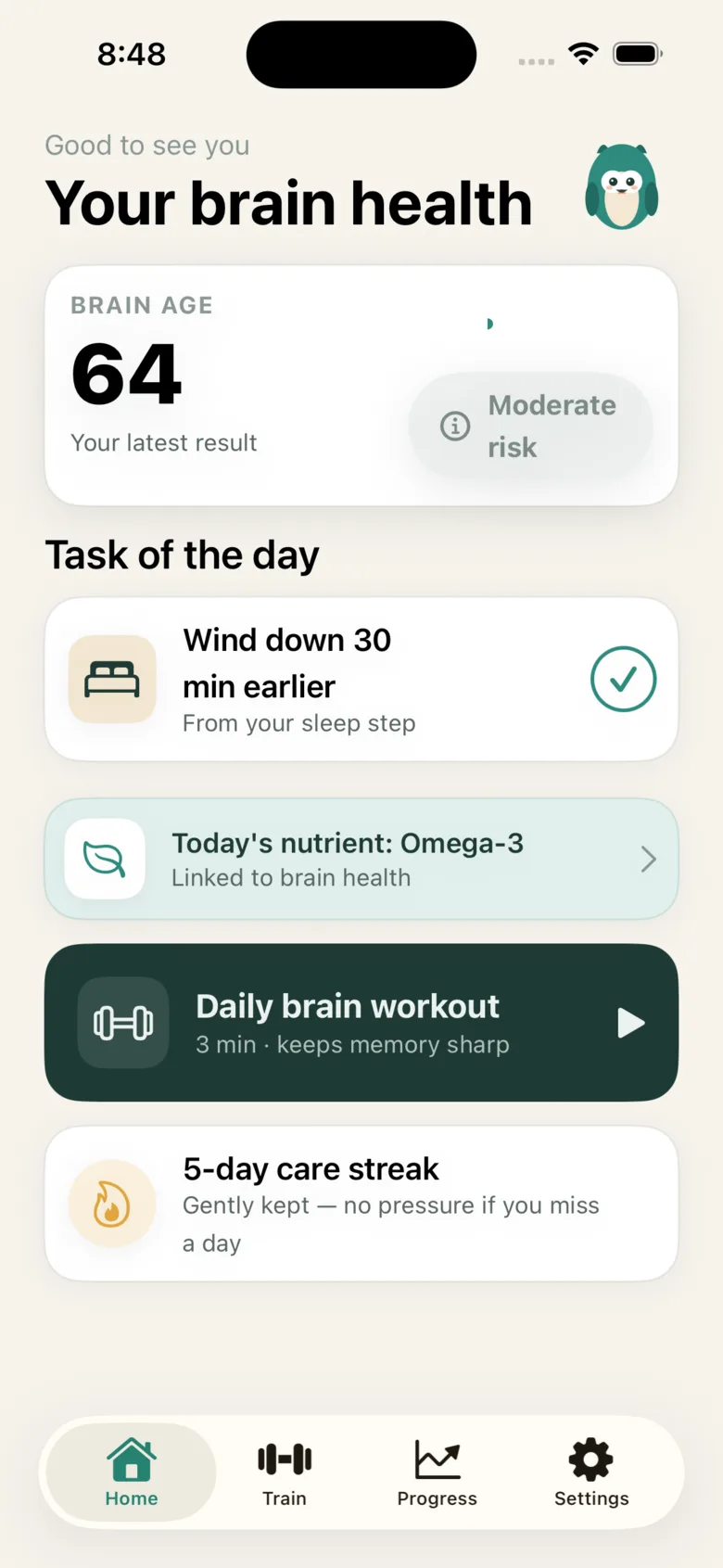
The Lancet 2024 Commission found 14 risk factors you can actually change. Your plan picks the ones your answers point to and turns each into one concrete step, with the reason it matters.
Built for eyes over forty
Large type, generous targets, and a senior mode that grows everything again for a parent using it. No streak shaming, no timers pressing you, no red.
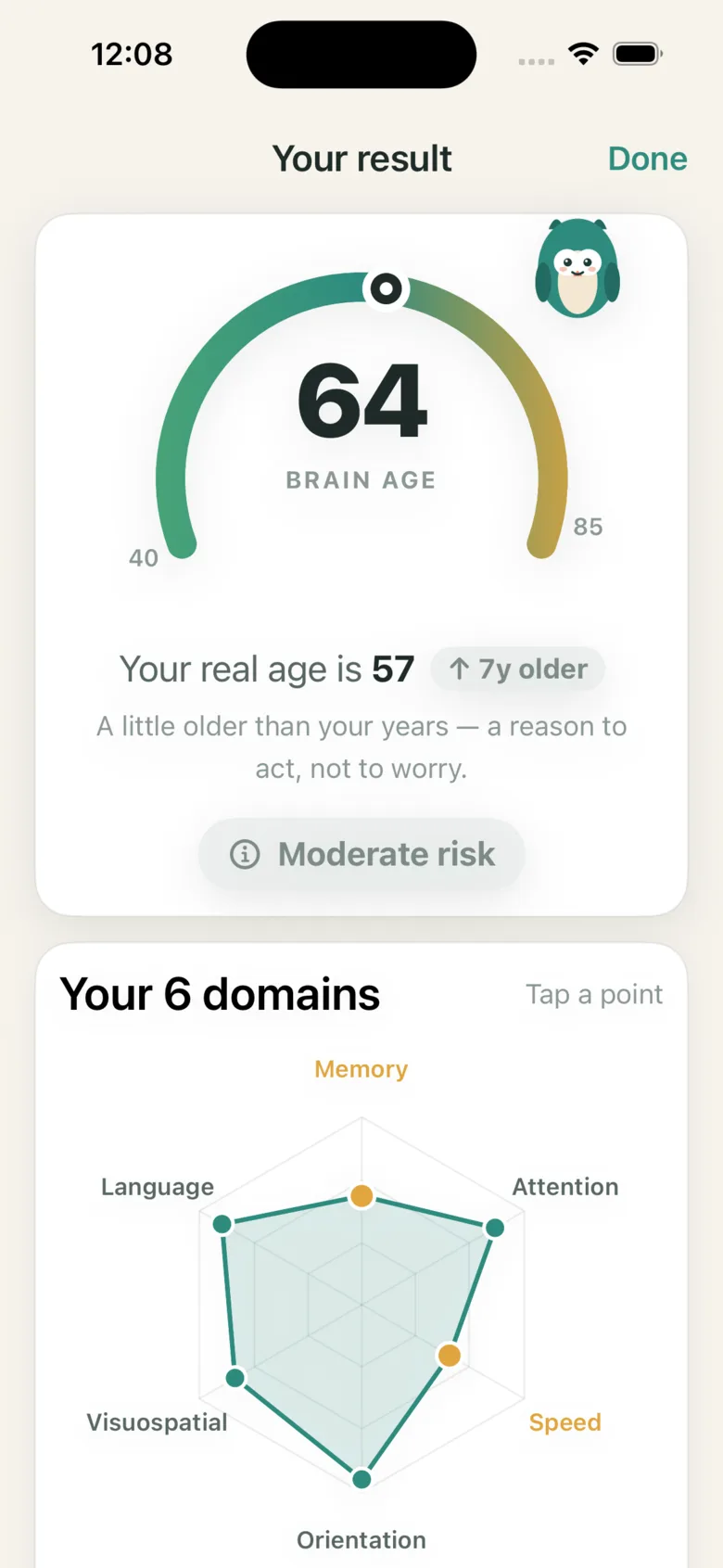
Same screen, two sizes. Senior mode grows every element for a parent using it — the difference is real, not a setting buried in a menu.
Grounded in published research
SAGE
The cognitive tasks are modelled on the Self-Administered Gerocognitive Exam developed at Ohio State University.
Lancet 2024
The risk questions follow the Lancet Commission's 14 modifiable risk factors for dementia.
On your device
Scoring runs on the iPhone. Nothing about your health is sent anywhere.
NeuroAge is not affiliated with either — it applies their published findings.
Nobody should have to choose between not knowing and being frightened.
Tap when it turns teal.
Every gauge starts here.
That's one domain of six, in ten seconds. The app measures all six in five minutes — then tells you what to do about it.
Get the full checkA demo, not a result — one task can't measure a brain.
Three steps, about five minutes
Answer
A short questionnaire about sleep, movement, hearing, blood pressure and family history: the things the research says actually move the needle.
Play
Four short cognitive tasks: remember five words, place today's date, react to a colour, recall the words. No wrong answers, no clock shouting at you.
Get your number and your plan
Brain age, risk band, six-domain radar, and the steps that lower it.
What Plus adds
Everything above is free. Plus is for the part that comes after the first number.
- The complete read of all six domains, not just the two that stood out
- The daily brain workout
Plus is available in the app — no free trial, cancel anytime.